Event 1
Murder of Joseph Wieder
The [Murder of Joseph Wieder](entity:event-recall-event-murder-of-joseph-wieder-0ec96119d037), the killing of Professor [Joseph Wieder](entity:character-recall-character-joseph-wieder-b197efcd3c56) at his home on the night of [21–22 December 1987](entity:time-recall-time-1987-12-21-22-de9458072791), is the unsolved crime around which the competing accounts of [Richard Flynn](entity:character-recall-character-richard-flynn-c9f56abe2609), [Derek Simmons](entity:character-recall-character-derek-simmons-95698181529e), and [Laura Baines](entity:character-recall-character-laura-baines-a593afcbeb41) converge. The coroner reconstructed a violent attack from the pattern of Wieder’s injuries, but the locked house, missing pieces of testimony, and disputed credibility of witnesses prevented that reconstruction from identifying a killer. When [John Keller](entity:character-recall-character-john-keller-d6cf54623bee) later examines the case, each new account sharpens some details while making the whole harder to see clearly.
## The attack and discovery
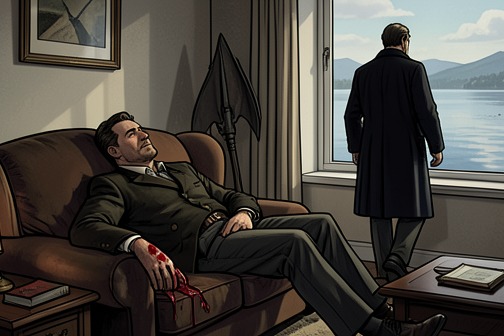
The coroner placed Wieder’s death at about 2 a.m. and concluded that he had died from internal and external blood loss caused by blows from a blunt object, probably [The Baseball Bat Used to Murder Wieder](entity:object-recall-object-wieder-2352f7c1d7cf). Investigators believed the assault had begun around midnight, with a single attacker approaching from behind while Wieder sat on the living-room couch. The first blow did not end the struggle: Wieder rose and tried to flee toward the window overlooking the lake, using his arms to defend himself. Both forearms were fractured. He then turned back to face his attacker in the middle of the room, and the television fell from its stand during the struggle.
The final blow struck Wieder near his left temple. He survived for roughly two hours, but the severe brain injury and cardiac arrest proved fatal. Because the fatal strike landed on the left side of his head, investigators inferred that the attacker was probably right-handed. This was a reconstruction of the attack, not an identification: it described the violence and its sequence without establishing who had delivered the blows.
Derek Simmons discovered the body the next morning. At 6:44 a.m. on 22 December, he called 911 from [Joseph Wieder’s residence](entity:location-recall-location-joseph-wieder-f41b0e35901f) and reported finding the professor lying in a pool of blood in the living room. Paramedics could do nothing, and an assistant medical examiner formally pronounced Wieder dead. Simmons was the person who found the body, but his later status as a witness and potential suspect made that discovery part of the case’s uncertainty rather than a simple endpoint to the night’s events.
## What the scene suggested—and did not
Simmons said the front door and the windows had been locked when he arrived, and investigators found no sign of forced entry. They therefore supposed that the killer had possessed keys, entered without breaking in, surprised Wieder, and locked the door on leaving. The murderer had also rummaged through the living room. Yet robbery appeared an unlikely explanation: Wieder still wore a Rolex and a valuable gemstone ring, about a hundred dollars remained in an unlocked drawer, and none of the valuable antiques had been taken. The search suggested that something had been sought, but the surviving evidence did not establish what it was.
Two recently used glasses in the living room indicated that Wieder had shared a drink with one other person that evening. He had consumed a significant quantity of alcohol; his blood-alcohol level was 0.11. The medical examiner found no narcotics or medication in his body. The glasses supported the presence of a companion, but did not name that person or prove the companion had remained until the attack.
The detectives also considered whether a romantic motive might explain the killing. At the time, however, Wieder was not known to have a partner or mistress, and friends and colleagues could not recall him dating anyone recently. They consequently considered a crime of passion unlikely. Later accounts raised the possibility of a relationship between Wieder and Laura Baines, but the possibility was never proven. The gap between what investigators could establish and what witnesses suspected became one of the case’s defining features.
## The investigation and its suspects
Richard Flynn came under repeated scrutiny. He had worked in the [Firestone Library](entity:organization-recall-organization-firestone-librar-6d9f0f4d99ff) and was hired to organize Wieder’s library using a computer system. Wieder gave him keys because the professor often travelled and Flynn sometimes worked at the house when he was away. Flynn had also been there socially: Wieder invited him to dinner on several occasions, and the two had shared meals. The keys and Flynn’s connection to the house made his presence there important to investigators, although access alone could not establish guilt.
Flynn was interviewed repeatedly, but was never officially declared a suspect or charged. He hired an attorney, George Hawkins, who accused the police of harassment and argued that they were trying to make Flynn a scapegoat for their own incompetence. Press accounts described Flynn as a suspect for a time, after Simmons had been cleared on the strength of a strong alibi. The distinction between journalistic description and official action matters: Flynn faced sustained questioning, but the investigation did not produce a charge against him.
The inquiry also examined whether someone might have sought revenge over Wieder’s work as an expert witness in criminal cases. Detectives reviewed trials in which his testimony had harmed defendants, but that line of inquiry led nowhere. Nor did the prosecutors identify another viable lead. They ultimately did not accuse anyone of Wieder’s murder, and the [West Windsor](entity:location-recall-location-west-windsor-a4426b1cd496) case became cold. Despite extensive investigation, the police never found the perpetrator.
## Conflicting testimony and the limits of belief
Years later, Simmons told Keller that he knew who had killed Wieder and had tried to tell the police at the time. He believed his statement had been dismissed because he had previously been accused of murder, confined in a psychiatric institution, and treated with medication. In his view, those circumstances would have allowed others to portray him as delusional. His claim placed the problem of credibility at the centre of the case: a witness could insist that he had seen something clearly while anticipating that his history would make his account easy to discount.
Simmons’s later account implicated Flynn and raised the possibility that Laura had also been present. He said Flynn had argued with Wieder, and he suspected that Flynn had killed the professor while Laura was either an accomplice or a witness. Simmons also said that he had withheld Laura’s name from the police because he feared that publicity would tarnish Wieder’s reputation; he had reported only that Flynn was there and had argued with the professor. His suspicions about Laura and Wieder were not firsthand proof of a sexual relationship: Simmons said he had not seen them together sexually, though he believed Laura sometimes stayed overnight.
A former detective told Keller that the police had known about Laura and interviewed her. The detective recalled that the allegation that she was involved with Wieder could not be proved, and that she had a strong alibi for the evening. This account complicates the earlier impression that Laura’s name had been kept from investigators, without resolving whether her relationship with Wieder had any bearing on the killing. Simmons’s memory was itself questioned: the detective recalled him as ill and amnesiac, and doubted that his statement could be used as proof.
Simmons’s version also conflicted with [Frank Spoel](entity:character-recall-character-frank-spoel-0e4d7bb194da)’s account. Spoel said he had hidden in the backyard that evening, but described Wieder with Flynn and recalled neither Laura’s presence nor an argument. When Keller confronted Simmons with the discrepancy, Simmons suggested that Spoel might have forgotten or might be lying. Neither possibility could settle the conflict. The accounts leave the reader with incompatible witness claims rather than a confirmed sequence of events.
## An unresolved reconstruction
The murder remains unresolved even as its physical outline grows unusually precise: the approximate time of the attack, the likely point of entry, Wieder’s attempt to defend himself, and the fatal injury can all be reconstructed, while the identity and purpose of the attacker remain unknown. The locked doors suggest access by someone with keys; the glasses suggest a companion; the rummaged room hints at a search; none of these clues, separately or together, proves who killed Wieder or why.
For Keller, the investigation becomes a maze of details that refuse to form a single reliable picture. The case begins among the questions surrounding Flynn and his missing manuscript, but Wieder’s death draws other people, documents, and disputed recollections into the foreground. The result is not a solved mystery but a record of how incomplete evidence distributes suspicion: physical traces establish the violence, while memories and alibis pull the possible story in opposing directions.
Event 2
Murder of Anne Simmons
The murder of [Anne](entity:character-recall-character-anne-8255533dffd4) Simmons is the event that turns the apparently settled life of a [Princeton, New Jersey](entity:location-recall-location-78c2a981b77e), couple into a criminal case—and, through [Joseph Wieder](entity:character-recall-character-joseph-wieder-b197efcd3c56)’s assessment of [Derek Simmons](entity:character-recall-character-derek-simmons-95698181529e), a question about whether the accused man could remember his own actions. The account reaches the reader retrospectively: [Laura Baines](entity:character-recall-character-laura-baines-a593afcbeb41) tells [Richard Flynn](entity:character-recall-character-richard-flynn-c9f56abe2609) what she learned from Wieder, so the killing is presented through several layers of testimony rather than as a directly witnessed scene. An affair and a trail of suspicious circumstances point toward Derek, while his persistent claim of innocence and Wieder’s diagnosis complicate the apparent explanation.
## The Marriage and the Night of the Killing
Anne and Derek had been married for five years and had no children. Derek worked as a maintenance man; Anne was a waitress at a coffee shop on Nassau Street. Neighbours and family friends later described them as a happy couple who did not argue. That public picture makes the case’s later account of an affair and a possible marital confrontation especially consequential: the murder appears not as the culmination of a known pattern of conflict, but as a rupture in a marriage others believed was peaceful.
Derek said that he returned home at about seven in the evening after shopping nearby, ate, watched television, and went to bed. Anne was working the evening shift and, he said, was not expected home until late. Early the next morning, he called for an ambulance and told the operator that his wife was seriously ill. Paramedics found Anne lifeless in the hall, in a pool of blood, with repeated stab wounds to her neck and chest. An assistant medical examiner pronounced her dead at the scene, and investigators were called in. The account establishes the stark sequence of discovery and response, but it does not show the killing itself or independently settle what happened between the couple that night.
## Evidence and the Prosecution Theory
Investigators found that Anne had been having an affair for several months. Her lover’s identity was never discovered—or at least never made public—but the relationship appeared serious: the two reportedly planned to marry after Anne filed for divorce. On the night she died, Anne finished work and locked the café at around ten. She and her lover went to a cheap, one-bedroom apartment on the same street, which Anne had rented two months earlier, and stayed until around midnight. A taxi driver and the meter record placed her return home at 1:12 a.m.
Derek said he knew nothing about the affair. Investigators considered that claim highly unlikely and saw jealousy as a possible motive. They also noted defensive wounds on Anne’s arms, consistent with an attempt to ward off an attacker using a large knife. Two neighbours later said they had heard screams, though neither called the police because the sounds stopped before they had fully woken. These details strengthened suspicion, but they did not directly identify the killer. The lover remained unknown, and the evidence about the murder was assembled into a theory rather than witnessed as a complete sequence.
That theory placed Anne’s return at 1:12 a.m., followed by an argument in which Derek confronted her about the affair and she may have said she intended to seek a divorce. Detectives proposed that about two hours later he took a knife from the kitchen and killed her, disposed of the weapon, and called an ambulance as though he had only just found her body. The proposed sequence made the ambulance call appear to be part of a cover story. Yet the account presents it as the detectives’ reconstruction, not as an established confession; Derek continued to claim he was innocent and refused to accept a deal.
## Wieder’s Diagnosis and the Case’s Uncertainty
The accusation was further complicated by Derek’s history of mental illness. As a teenager, he had suffered a severe breakdown and spent two months at [Marlboro mental hospital](entity:location-recall-location-9c9552674c2b), missing his final year of high school. He had been diagnosed with schizophrenia and continued taking medication after his release. Once a very good student, he abandoned the prospect of college, qualified as an electrician, and took a low-level job at [Siemens](entity:organization-recall-organization-siemens-1608a2ad199e). The history gave investigators and his lawyer grounds to consider his mental state, but it did not by itself prove what had happened on the night Anne died.
After examining Derek several times, Wieder concluded that the earlier schizophrenia diagnosis was wrong and that Derek had a rare dissociative disorder involving periodic fugue states. In such episodes, a person could lose self-awareness, memory, and a sense of identity; in extreme cases, people might disappear and live under a different identity without remembering their former life. Wieder thought it possible that Derek did not remember what he had done, if he had acted during a state brought on by stress and the altered consciousness of moving suddenly from sleep to waking. This possibility does not confirm either the killing or Derek’s innocence; it changes the central question from motive alone to the relationship between action, memory, and responsibility.
Wieder’s report persuaded the court to commit Derek to [Trenton mental hospital](entity:location-recall-location-d246a049ae48) alongside other potentially dangerous patients. With the institution’s and his lawyer’s agreement, Wieder continued treating him through therapy that included hypnosis and an experimental mixture of anticonvulsant drugs. The murder therefore has consequences beyond the investigation: it becomes the reason Derek is confined and treated, while the diagnosis that helps explain his possible memory loss also leaves the case dependent on a disputed account of his mental state. As Laura relays the history to Richard, the killing remains both the case’s decisive crime and the point at which apparently clear evidence gives way to uncertainty.
Event 3
Derek Simmons's hospital attack
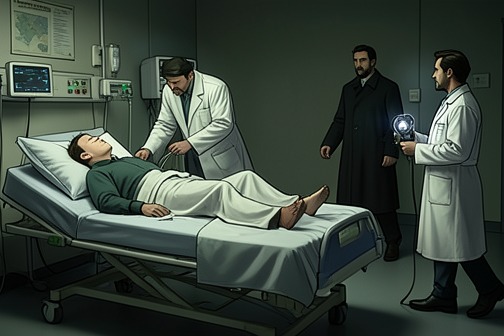
[Derek Simmons](entity:character-recall-character-derek-simmons-95698181529e)’s hospital attack transformed a psychiatric commitment into a lasting rupture in his identity: although his brain could form new memories, the past he had lived before the assault became inaccessible to him. The injury also shaped how others later judged his testimony about the crimes surrounding [Joseph Wieder](entity:character-recall-character-joseph-wieder-b197efcd3c56).
## Diagnosis and the Hospital Attack
After examining Simmons several times, Wieder concluded that he had a rare dissociative disorder and had been wrongly diagnosed with schizophrenia when young. Wieder’s account described episodes of fugue in which a person could lose self-awareness, memory, and any sense of identity, sometimes disappearing and living under a different identity. He considered it possible that Simmons might not remember what he had done on the night in question, having reacted under stress and in a state of altered consciousness while abruptly waking from sleep.
Wieder’s report persuaded the court to commit Simmons to [Trenton Psychiatric Hospital](entity:location-recall-location-trenton-psychiatric-f51e12b71666). With the institution and Simmons’s lawyer in agreement, Wieder continued treating him there with hypnosis and an experimental combination of anticonvulsant drugs. After several months, another patient attacked Simmons, leaving him with a serious head wound that substantially worsened his condition.
The consequences were profound and permanent: Simmons lost his memory, and the memories from before the attack never returned. He could still form and store new memories, but the injury had made his earlier life inaccessible—a condition Laura identified as retrograde amnesia. The distinction became central to the account of his later life: Simmons retained abilities acquired before the assault, yet could no longer remember the personal history through which he had acquired them.
## Reconstruction and Supported Independence
A year after the attack, at Joseph Wieder’s insistence, Derek Simmons was transferred to [Marlboro Psychiatric Hospital](entity:location-recall-location-marlboro-psychiatric-339226307fc0), where the less restrictive regime gave Wieder room to help him rebuild a life. That reconstruction restored a name and outward identity, not his autobiographical memory. Simmons could write without remembering school, and work as an electrician without remembering how he had learned the trade; the memories of his earlier life remained inaccessible even as the skills endured.
In spring 1985, a judge approved Simmons’s discharge because of the case’s complexity and his complete lack of violent tendencies. But release did not mean he could manage alone. He had no employment prospects, his mother had died when he was a toddler, and his estranged father had left without a forwarding address. Wieder rented him a small one-bedroom apartment near his own home and paid him to maintain the house. Simmons lived by himself, and neighbours regarded him as a freak; when he shut himself away for days or weeks, Wieder brought him food and checked that he took his medication.
The arrangement made Wieder more than Simmons’s former doctor: it supplied housing, paid work, treatment, and the practical care that made life outside an institution possible. Simmons revered him and seemed gentle and incapable of harming anyone. He also adopted a shelter puppy, Jack, and took him for an evening walk in the nearby park. These modest routines show the fragile, supported independence that followed the loss of his past.
## The Return of Memory and the Cost of Testimony
The assault’s effects did not remain a simple, permanent blank. In mid-March [1987](entity:time-recall-time-1987-0da5bb436088), while watching [NY1](entity:organization-recall-organization-ny1-100220f47315), Simmons recognized a man reported to have died by suicide as Stan Marini, a former member of the maintenance crew at [Siemens](entity:organization-recall-organization-siemens-1608a2ad199e), where Simmons himself had once worked. The connection mattered because no one had told him about it and he had not read it; he took the recognition as evidence that something from his buried past was surfacing independently. He described the change as a lid lifting and memories rushing up at extraordinary speed. This moment complicates the earlier account that his pre-injury memories could not be recovered: it records a sudden return of material, not proof that his autobiographical past had been restored in full.
That uncertainty shaped the value others assigned to Simmons’s claims about Joseph Wieder’s murder. He later told [Roy Freeman](entity:character-recall-character-roy-freeman-e521f39f4d5e) that he knew who had killed Wieder and had said so at the time, but believed his statement had been dismissed because he had previously been accused of murder, confined in a psychiatric hospital, and treated as mentally ill. His account was specific: he believed [Richard Flynn](entity:character-recall-character-richard-flynn-c9f56abe2609) had stayed nearby after leaving Wieder’s house, returned, and killed the professor, while [Laura Baines](entity:character-recall-character-laura-baines-a593afcbeb41) was either an accomplice or a witness. Simmons said he had withheld Laura’s name from the police because he feared publicity would tarnish Wieder’s reputation.
The account was not stable across tellings. When Freeman compared it with [Frank Spoel](entity:character-recall-character-frank-spoel-0e4d7bb194da)’s version, Simmons had placed himself hiding in the backyard at the same time Spoel said he was there, yet the two accounts differed over Laura’s presence and whether Flynn and Wieder had argued. Simmons suggested Spoel might have forgotten or lied, but the contradiction left his own testimony under suspicion. Earlier, police had also treated his amnesia and illness as reasons his statement could not be used, while noting that there was no proof of an affair between Laura and Wieder and that she had an alibi. The attack thus continued to govern the investigation long after the wound healed: Simmons’s lost past, emerging recollections, and psychiatric history made him both a possible witness to the murder and a witness whose credibility could not be settled by conviction alone.
## The Attack Within a Larger Problem of Memory
The hospital attack gives the novel’s inquiry into memory a concrete, bodily rupture, but it sits beside a different danger: recollection can feel vivid and still have the wrong source. Laura explains that Richard had long believed he watched the 1970 Super Bowl, only to recognize that he was four at the time and knew the game through his father’s repeated stories. A remembered scene can therefore be assembled from what was heard and later mistaken for what was lived; Simmons’s lost past raises the inverse problem, in which abilities survive after the personal experiences behind them have vanished.
Wieder’s mall experiment sharpens that contrast. Under hypnosis, three-quarters of students who could not recall getting lost in a mall came to describe such an event, including their fear, their recovery by clerks, and announcements over the speakers. Their detailed certainty did not establish that the event had happened. Against these examples, Simmons’s injury cannot simply be treated as a universal explanation for unreliable testimony: it accounts for a profound break in his access to the past, while the novel’s other cases show how memory can also be reshaped by suggestion, stories, and inference. The attack thus leaves the investigation with no easy equation between confidence and truth, or between memory’s absence and the absence of evidence.
Event 4
Joseph Wieder Murder Case
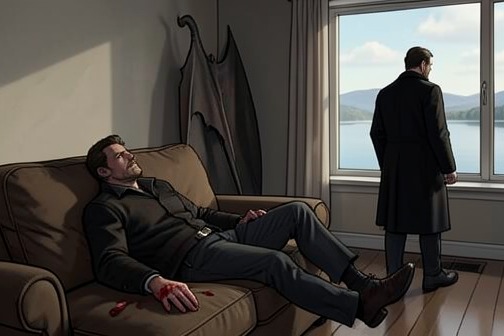
The [Joseph Wieder Murder Case](entity:event-recall-event-e6e0fe207310) concerns the [21 December 1987](entity:time-recall-time-21-december-1987-2ae443c5998d) beating of Professor [Joseph Wieder](entity:character-recall-character-joseph-wieder-b197efcd3c56) in his own home, but its defining mystery is not simply who struck the fatal blows. [Derek Simmons](entity:character-recall-character-derek-simmons-95698181529e) described [Richard Flynn](entity:character-recall-character-richard-flynn-c9f56abe2609) as the likely killer and [Laura Baines](entity:character-recall-character-laura-baines-a593afcbeb41) as an eyewitness or accomplice; [Frank Spoel](entity:character-recall-character-frank-spoel-0e4d7bb194da) later claimed that he had attacked Wieder alone. Their accounts diverge over who was present, when the assault occurred, and who entered the house afterward. The case’s central evidence is therefore also a contest over credibility: a witness whose testimony was discounted because of illness and amnesia, a later confession that conflicts with his account, and an investigation that never settled the contradictions.
## Background and Initial Investigation
Wieder was a professor with a quiet life, according to the investigator [John Keller](entity:character-recall-character-john-keller-d6cf54623bee)’s later recollection. He lived in a good neighborhood, had no known recent conflicts, and was not associated with drugs, prostitution, or other criminal activity. Yet he was beaten to death at home. Valuable possessions, including cash and jewelry, were left behind, while the disorder suggested that someone had searched the rooms in haste: drawers stood open and papers lay scattered across the floor. The fingerprints recovered belonged to people already known to have access to the house, including a young man who tended Wieder’s library and a janitor who visited regularly.
Keller remembered arriving at the house with the forensic team amid intense press attention. The scene offered no obvious working theory, and the apparent absence of theft sat uneasily beside the scattered papers. Investigators interviewed Richard Flynn several times because he admitted being at the house that night and was believed to have been the last person to see Wieder alive. Flynn said he had left two or three hours before the murder, and the interviews did not establish otherwise.
Laura Baines was also known to police. Keller recalled that investigators were aware of the suggestion that she and Wieder were romantically involved, but could not prove it. He interviewed her, yet she had what he remembered as a strong alibi for the entire evening, reportedly confirmed by a female schoolmate. With no proof of an affair and an alibi that appeared to exclude her from the scene, the inquiry treated her as a dead end. The distinction between rumor and demonstrable evidence would later matter: both the alleged relationship and Laura’s presence became central to competing reconstructions, but neither was established by the investigation Keller recalled.
## Derek Simmons’s Account
Years later, Derek told John Keller that he knew who had killed Wieder, though he had expected his original statement to be dismissed. Derek said that, because he had previously been accused of murder, institutionalized, and given various pills, lawyers and police would have treated him as unreliable or as someone who had hallucinated. He nevertheless insisted that he knew what he had seen. His confidence did not remove the problem of how much weight his testimony could bear; it made that problem part of the case itself.
Derek placed himself at Wieder’s house on the morning of the murder to repair a downstairs toilet. Wieder was packing for a holiday trip to the Midwest and invited him to lunch, ordering Chinese food. During the visit, Wieder appeared tired and worried. He told Derek that footprints left in the snow in the backyard looked suspicious and promised to continue looking after him while reminding him to keep taking his medication. Derek left at about two in the afternoon to paint an apartment near campus.
After dinner that evening, concerned about Wieder, Derek went back to the house. He saw Laura’s car nearby and heard an argument inside. From the backyard beside the lake, he could see Wieder, Laura, and Richard in the lit living room. Laura and Wieder were seated at a table; Richard stood over them, gesturing and shouting. A few minutes later Laura left without either man trying to stop her. Richard and Wieder continued arguing, then appeared to settle down: they smoked, drank coffee and a couple of glasses of liquor, and the atmosphere seemed calmer. The argument flared again shortly after ten. Richard left, and Derek went around the house to catch him, but found him gone within twenty or thirty seconds. Derek later saw Laura’s car back near the house and assumed she had returned to spend the night with Wieder.
Derek said he returned the next morning, rang the bell, and, when nobody answered, used his own keys. He found Wieder’s body in the living room. He believed Richard had not truly left the night before but had hidden nearby and returned to kill Wieder; he also thought Laura might have helped or witnessed the attack, since he believed she was in the house and could not have overpowered the professor by herself. Derek acknowledged that he had not told police about Laura, fearing that newspapers would tarnish Wieder’s reputation. He had instead reported that Richard had been there and argued with the professor. He did not claim to know for certain that Laura and Wieder were lovers, though he said she sometimes stayed overnight and that Richard had told him he was infatuated with her.
## Spoel’s Confession and the Conflicting Timeline
Frank Spoel offered a sharply different account. Before the murder, he had watched Wieder’s house on several evenings, usually arriving in the backyard after the diner where he worked closed. He noticed a young man who seemed like a student and a tall, bearded handyman visiting the professor, but said neither stayed overnight. Spoel planned to leave [New Jersey](entity:location-recall-location-new-jersey-25586b9a9d1c) with his friend Chris Slade, a bartender from [Missouri](entity:location-recall-location-missouri-a13afe2b2cd5) who had found work at a trailer park in [St. Louis](entity:location-recall-location-st-louis-3209059f9698). The prospect of leaving soon helped make events move quickly.
Spoel said that on 21 December he resigned from the bar, collected his cash and two packs of cigarettes, and went to a woodshed near [Assunpink Creek](entity:location-recall-location-assunpink-creek-5ecbaa2d74a3) to avoid being seen until dark. He arrived at Wieder’s house at around nine and saw the professor drinking in the living room with a young man. In Spoel’s telling, there was no woman. He said the young man stayed until about eleven; after waiting another ten minutes to make sure he had gone, Spoel entered through a window Wieder had opened onto the backyard and hid in the corridor. When Wieder came downstairs, shut the windows, and sat on the couch looking at papers, Spoel crept up behind him and hit him with a baseball bat. Wieder got up and turned toward him, so Spoel went around the couch and struck him repeatedly—ten or twelve times, by his estimate—until he fell. Wearing a mask, Spoel fled through the glass door when he heard someone opening the front door.
Spoel said he threw the bat into a partly frozen stream and spent the night in the woodshed near Assunpink Creek. The next morning he met Slade at [Princeton](entity:location-recall-location-princeton-a416f496f017) Junction, and they left for Missouri. He later learned that Wieder had died. Spoel described the assault as the act that made him a killer and said that afterward, when he did something wrong, it could feel as though he were waking from a dream and could not believe he had done it. His explanation linked his sense of estrangement from his actions to the pills he had received in the institution, but did not settle whether his memory of this crime was accurate.
## Evidence, Credibility, and Unresolved Possibilities
The two accounts cannot both describe the evening accurately. Derek placed himself in the backyard around nine, said he saw Laura and Richard with Wieder, and described a loud argument that continued after Laura left. Spoel also placed himself in the backyard at around nine, but said he saw only Wieder and a young man, noticed no disagreement, and saw that man leave at about eleven. Derek’s account has Laura returning to the house; Spoel’s has no woman present. Their accounts also differ over the sequence of departure and entry: Derek said Richard vanished almost immediately after leaving, while Spoel said he waited until the young man had been gone before going inside.
The question of who arrived after the beating creates another gap. Spoel said he fled when he heard the front door opening. Keller’s later summary raised the possibility that someone reached the house around midnight, found Wieder on the floor, and failed to call an ambulance. If Spoel’s account were true, that person would have entered with a key rather than ringing or knocking. Derek’s account that he used his keys to enter the following morning does not identify who might have arrived earlier, and the surviving accounts do not establish that the supposed midnight visitor was Laura or anyone else.
Keller suspected that Laura had been in the house during the murder and stolen Wieder’s completed manuscript, which was about to be sent to its publisher. He considered the possibility that Laura and Richard had acted together: Richard wielding the bat, with Laura as the instigator and the person who stood to gain. Spoel’s version suggested a different possibility. If his testimony were true, Laura could have arrived by chance after the attack, taken the manuscript, closed the glass door through which Spoel escaped, and locked the entrance behind her. That reconstruction could help explain why Derek later found the doors and windows closed, but it remains a hypothesis rather than an established sequence.
The case consequently turns on more than the identity of an assailant. Derek’s testimony was discounted in part because he was ill and had amnesia; Keller recalled that police considered there was little they could do with his statement. Yet Spoel’s confession does not simply resolve the matter: it contradicts Derek’s description of the people and events at the house, and its own details leave the later entry and the missing manuscript unexplained. When confronted with the discrepancies, Derek suggested Spoel might have forgotten or lied and challenged Keller’s decision to believe him instead. The case’s significance lies in that unsettled exchange: the accounts offer vivid, incompatible scenes, while the evidence presented does not conclusively reconcile them.
Event 5
Frank Spoel’s Confession to the Wieder Murder
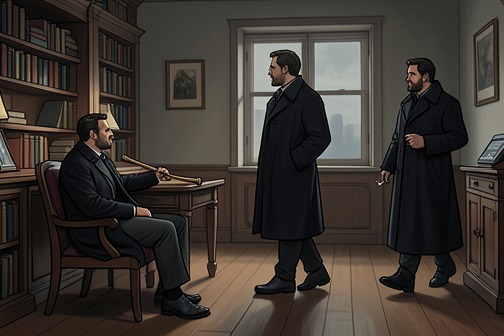
[Frank Spoel](entity:character-recall-character-frank-spoel-0e4d7bb194da)’s confession to the murder of [Joseph Wieder](entity:character-recall-character-joseph-wieder-b197efcd3c56) seemed to supply the long-missing answer to a case built on incompatible memories and discounted testimony. In an interview arranged by [Roy Freeman](entity:character-recall-character-roy-freeman-e521f39f4d5e) at [Potosi Correctional Center](entity:location-recall-location-potosi-correctional-efb98f26adc3), Spoel admitted that he had attacked Wieder with a baseball bat. He described a revenge plot and a brutal assault, but said he had intended to beat Wieder, not kill him. His account appeared to settle the question of who had entered the house that night; instead, its gaps and contradictions eventually exposed a second assailant and a different account of how Wieder died.
## The confession and its circumstances
The confession reached Roy through [Matt Dominis](entity:character-recall-character-matt-dominis-fc9cc273b4db), who reported that someone had admitted to the murder. Still troubled by the case, Roy asked to interview Spoel before his scheduled execution. He was not convinced that the confession was genuine: Spoel might have heard about the case and hoped that an author investigating it would put his name in a book. Roy wanted to assess the man directly and hear his version of the [West Windsor](entity:location-recall-location-west-windsor-a4426b1cd496) murder.
At the prison, cigarettes served as a practical overture. Roy brought a carton of Camels, knowing they were valuable currency inside, but explained that staff would have to inspect it before Spoel could receive it. Spoel said he had no one on the outside, had not seen his parents for more than twenty years, and was frightened by the prospect of his execution in four weeks. He then acknowledged killing Wieder, while distinguishing the intention he claimed to have had from the result: he had wanted to hurt the professor and take revenge, not send him to the morgue. He connected his sense of having become a killer to his earlier experience in a mental institution and the pills he had taken there.
## A revenge plot and the night of the attack
Spoel said he had been released from the [Trenton Psychiatric Hospital](entity:location-recall-location-trenton-psychiatric-f51e12b71666) in October [1987](entity:time-recall-time-1987-0da5bb436088). With his former belongings gone, his gang unwilling to associate with him, and little support beyond a few days of shelter from an acquaintance, he found work washing dishes near [Princeton](entity:location-recall-location-princeton-a416f496f017) Junction. He said he believed Wieder, a man named Duanne, and perhaps others had involved him in a scheme using subjects for secret experiments. Convinced that Wieder had wronged him, Spoel followed the professor and decided to take revenge before leaving [New Jersey](entity:location-recall-location-new-jersey-25586b9a9d1c). A friend, Chris Slade, had found work in [St. Louis](entity:location-recall-location-st-louis-3209059f9698) and invited him to go along, giving Spoel a reason to move his plans forward.
Spoel described choosing Wieder’s isolated house as the site of the assault after watching it over several evenings. He said he obtained a baseball bat from some children, wrapped it in an old towel to soften the blows, and hid it by the lake. On December 21, 1987, he left his job, went to [Assunpink Creek](entity:location-recall-location-assunpink-creek-5ecbaa2d74a3), and waited in a woodshed until dark. From his stakeouts, he recognized two recurring visitors: a young man who appeared to be a student and a tall, bearded handyman. That evening, he said, he reached the house at about nine and saw Wieder drinking with the young man. He insisted that there was no woman present.
According to Spoel, the young man left at about eleven. Spoel waited another ten minutes, then entered through windows Wieder had opened onto the backyard and hid in the corridor. He said Wieder returned to the living room and sat looking through papers. Wearing a mask, Spoel crept up behind him and struck him with the bat. When Wieder got up, Spoel circled the couch and hit him repeatedly—ten or twelve times, by his recollection—until he fell. Hearing someone open the front door, Spoel fled without searching for money. He said he threw the bat into a half-frozen stream, spent the rest of the night in the woodshed, and left for [Missouri](entity:location-recall-location-missouri-a13afe2b2cd5) with Slade the next morning. He later learned that Wieder had died.
## Testimony that had already been set aside
The confession entered a case in which [Derek Simmons](entity:character-recall-character-derek-simmons-95698181529e) had already claimed to know who killed the professor. Simmons had told Roy that [Richard Flynn](entity:character-recall-character-richard-flynn-c9f56abe2609) was the attacker and that [Laura Baines](entity:character-recall-character-laura-baines-a593afcbeb41) had been a witness or accomplice. In his account, Flynn had argued with Wieder and stayed nearby after appearing to leave; Simmons also said he had found Wieder’s body the next morning. He acknowledged that he had not told police everything he believed about Laura, fearing that newspapers would exploit the allegation and tarnish Wieder’s name.
The earlier investigation had not treated Simmons’s account as dependable. One detective recalled that Simmons had amnesia, was ill, and could not offer much usable evidence. Laura had been interviewed, but investigators considered her alibi strong; although they knew of gossip that she and Wieder were lovers, they had no proof of an affair. Her possible presence therefore remained an unresolved lead, while Simmons’s claim about Flynn did not establish what had happened inside the house.
Spoel’s statement contradicted Simmons at precisely these points. Spoel placed Richard at the house but said he saw no Laura and noticed no argument. Roy also pressed him about the person Spoel said had opened the front door. Wieder died two or three hours after the attack, Roy observed, and a person entering at around midnight might have called for help. Spoel remained firm that someone had unlocked the door and walked in. The detail was not incidental: it left the possibility that another person had reached the injured professor after Spoel escaped.
## The confession’s limit and the later revelation
When Roy compared the two accounts directly with Simmons, Simmons did not engage seriously with the discrepancies, suggesting that Spoel might have forgotten or might be lying. That response did not resolve the conflict. Spoel’s detailed account made him responsible for the baseball-bat assault, but his insistence that another person entered the house remained unexplained, and his denial of Laura’s presence sharply diverged from Simmons’s version.
The later disclosure supplied the missing action. Simmons eventually said that he had returned to the house and found Wieder badly injured. Seeing Wieder’s eyes brought back his memory of following his wife, [Anne](entity:character-recall-character-anne-8255533dffd4), to a hotel room and listening outside the door while she was with Wieder. Simmons then struck Wieder once, hard, with a blackjack. He said he locked the door, threw the blackjack into the lake, and went home. He returned the next morning and did not learn that Flynn had not been the man who first attacked Wieder until Roy confronted him. Although the medical examiner placed Wieder’s death about two hours after the assault, Simmons maintained that Wieder had died immediately and said he felt no remorse for finishing what someone else had begun.
Spoel’s confession was thus true but incomplete: he had attacked Wieder, yet Simmons’s later admission identified the final blow. The story’s sequence of statements also shows why neither a confession nor an apparently precise eyewitness account could settle the case on its own. Spoel’s claim that someone entered the house had seemed peripheral beside his admission; in retrospect, it pointed toward the act that completed the murder. The confession changed the investigation not by closing the account, but by making its remaining silence newly legible.
Event 6
The Case of Derek Simmons’s Wife’s Murder
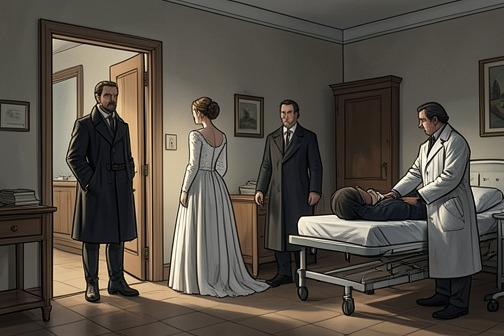
[The Case of Derek Simmons’s Wife’s Murder](entity:event-recall-event-32f9525c1e9a) is the 1982 case that placed [Derek Simmons](entity:character-recall-character-derek-simmons-95698181529e) inside the psychiatric and legal system before he became a witness in the investigation of [Joseph Wieder](entity:character-recall-character-joseph-wieder-b197efcd3c56)’s death. Simmons never admitted to killing his wife, yet the court found him not guilty by reason of insanity after an examination by Wieder. To the detectives who believed the evidence against him was conclusive, the ruling did not resolve the crime so much as remove a suspect they thought should have faced life in prison. Its consequences shaped Simmons’s later credibility, confinement, and release—and complicated how his claims about Wieder’s murder were judged.
## The accusation and the disputed verdict
The murder took place in 1982, several years after [Roy Freeman](entity:character-recall-character-roy-freeman-e521f39f4d5e) had moved to the [West Windsor Township Police Department](entity:organization-recall-organization-4c98566fb4a3). When Freeman later examined the [Princeton Police Department](entity:organization-recall-organization-d0bfdae7a3da)’s archived case file, he found that Simmons had not confessed. The decisive legal outcome was instead a finding of not guilty by reason of insanity, following an examination conducted by Wieder. The file thus recorded a distinction central to the case: Simmons was not convicted, but neither did the ruling establish that he had not killed his wife.
John T. Cooley, who described it as his first important murder case, remembered the department’s reaction as one of disgust. He had been with the department for a year and a half, handling minor matters before asking Quinn to make him a partner on the investigation. Cooley said he never doubted that Simmons had killed his wife. In his view, Simmons had seemed sane but cunning, and the psychiatric evaluation had frustrated the investigators who believed the evidence was solid. Cooley maintained that, had the case gone to trial, Simmons would have received life without parole. That was his assessment of what the evidence could have achieved in court, not the verdict the case actually produced.
Cooley also attributed a motive to Simmons: he believed Simmons had killed his wife because she was having an affair. The evidence supplied here does not independently establish either the affair or that motive. The account therefore leaves a sharp gap between the detectives’ conviction and the formal outcome. Investigators believed they knew who had committed the murder; the legal process, operating through the psychiatric assessment, reached a different result.
## Confinement, attack, and release
After his arrest, Simmons was held at [New Jersey](entity:location-recall-location-new-jersey-25586b9a9d1c) State Prison and then committed to [Trenton Psychiatric Hospital](entity:location-recall-location-trenton-psychiatric-f51e12b71666). The accident that caused his amnesia occurred at the hospital. Cooley later referred to an attack in which someone struck Simmons over the head, and said he had heard that Simmons had then truly lost his mind. The archived records establish the hospitalization and the amnesia-causing accident, while Cooley’s recollection supplies the investigators’ understanding of the attack and its consequences.
A year after the incident, once Simmons had physically recovered, he was transferred to [Marlboro Psychiatric Hospital](entity:location-recall-location-marlboro-psychiatric-339226307fc0). He was released two years after that, under supervision. Wieder played a consequential role in both decisions: his expert assessments helped persuade the judge to transfer Simmons to Marlboro and later to release him. The file also contained a 1994 court order lifting Simmons’s supervision, again following an expert assessment. Simmons’s path from prison to hospital, from one hospital to release, and finally out of supervision was therefore documented not as a single act of leniency but as a sequence of judicial decisions informed by psychiatric evaluations.
The case also became part of a changing legal climate. Cooley recalled that the law changed in 1984, a year after the case’s insanity ruling, following the attempted assassination of President Reagan and the assailant’s finding of not guilty by reason of insanity. He referred to the resulting [Insanity Defense Reform Act of 1984](entity:rule-recall-rule-insanity-defense-reform-003f88a1d72e). In Cooley’s account, that change underscored how little the department could do once experts had supplied a verdict the law recognized: the officers could believe Simmons guilty, but their certainty could not override the psychiatric determination.
## The case’s afterlife in the Wieder investigation
Years later, the Simmons case resurfaced when Roy Freeman investigated Wieder’s murder and assessed the testimony of Derek Simmons. Simmons told Freeman that he knew who had killed Wieder and had tried to tell the authorities at the time. He also explained why he believed his statement had been dismissed: because he had previously been accused of murder, confined in a psychiatric institution, and given many pills, he expected that lawyers would portray him as unreliable or hallucinating. Freeman found him deeply convinced that he had witnessed what he described.
Simmons’s account of the night of Wieder’s death implicated [Richard Flynn](entity:character-recall-character-richard-flynn-c9f56abe2609) and placed [Laura Baines](entity:character-recall-character-laura-baines-a593afcbeb41) at the house as well. He maintained that Flynn had hidden nearby, returned, and killed Wieder, while Baines was either an accomplice or a witness. Simmons said he had withheld Baines’s name from police because he feared the newspapers would tarnish Wieder’s reputation, though he eventually told them Flynn had been there and had argued with the professor. These were Simmons’s claims, not established findings of the wife-murder case or proof of what happened to Wieder.
The investigation exposed a direct conflict between Simmons’s account and [Frank Spoel](entity:character-recall-character-frank-spoel-0e4d7bb194da)’s. Both claimed to have been hiding near the house at the same time, but Spoel did not mention Baines and described Flynn and Wieder without the disagreement Simmons recalled. When Freeman confronted Simmons with the discrepancy, Simmons suggested that Spoel might have forgotten or might be lying, and challenged Freeman’s decision to credit the other witness. The earlier wife-murder case hung over that exchange: Simmons’s psychiatric history and amnesia offered reasons to doubt him, but they did not by themselves demonstrate that this particular account was false.
## Significance and limits of the record
The case matters in the larger narrative because it establishes both the basis for suspicion of Simmons and the institutional history that later shadowed his testimony. Cooley’s certainty and the department’s anger coexist with the court’s insanity finding; Wieder’s role in evaluating Simmons connects the earlier case to the murder investigation that follows. The record also gives concrete consequences to the verdict: imprisonment, psychiatric commitment, an attack, amnesia, transfer, release, and the eventual lifting of supervision.
The evidence does not settle the underlying question of whether Simmons killed his wife. Cooley’s confidence, his proposed motive, and his judgment that the evidence would have secured a life sentence remain the recollections of an investigator; the formal case record described by Freeman confirms the arrest’s aftermath and the insanity ruling, not a conviction. That unresolved difference is essential to the case’s later significance. Simmons enters the Wieder investigation already burdened by a history that invites disbelief, while the conflicting testimony itself requires scrutiny rather than automatic acceptance or dismissal.
Event 7
Frank Spoel’s Experimental Treatment at Trenton State Hospital
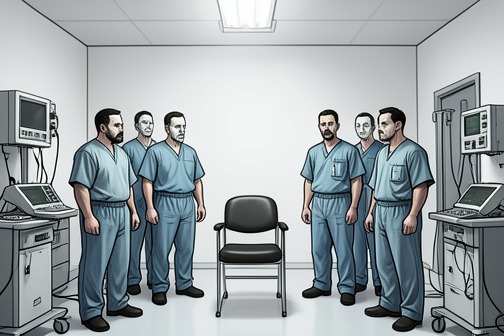
[Frank Spoel’s Experimental Treatment at Trenton State Hospital](entity:event-recall-event-c6204c8dcc0c) was a programme of experimental medication administered to Spoel and other inmates under the coordination of [Joseph Wieder](entity:character-recall-character-joseph-wieder-b197efcd3c56). Spoel’s account makes the treatment more than a background detail in the [1987](entity:time-recall-time-1987-0da5bb436088) murder investigation: its reported harms, the restrictions on his release, and his conviction that Wieder had exploited him help explain why he later targeted the professor. The account also complicates the status of Spoel as a witness, since the very psychiatric history that shaped his testimony was used to diminish its credibility.
## Entry into the Programme
Three weeks after Spoel’s admission to [Trenton Psychiatric Hospital](entity:location-recall-location-trenton-psychiatric-f51e12b71666), he said, he was transferred to a special ward with about ten other inmates. They were all between twenty and thirty years old and had been convicted of violent offences. Spoel later learned that the ward was being used for an experimental medication programme coordinated by Joseph Wieder. The patients were not, in Spoel’s description, there by choice or because they understood the purpose of what was being done to them; he presented them as subjects whose participation had not been meaningfully explained.
His placement followed a period of imprisonment and legal uncertainty. Spoel said that two men had stolen from him and that he had beaten one of them and taken eighty dollars from his wallet. He had expected that money to make up for his losses, but instead found himself facing at least a year in a psychiatric institution. His first lawyer, Duanne, told him that after a year he could apply to a judge for discharge or transfer to a less secure hospital. Spoel described the outcome as bewildering: a dispute over stolen cigarettes and money had led, in his view, to confinement and treatment far beyond what he believed his actions warranted.
## Treatment and Reported Effects
Joseph Wieder sometimes came to the ward, where he questioned the inmates, asked them to select colours, and had them complete questionnaires. Spoel remembered confronting him about why he was being held and treated, insisting that he was mentally sound. According to Spoel, Wieder replied that he had mental problems and should take the treatment, and that Spoel would remain there for as long as Wieder considered appropriate. The recollection presents a stark imbalance: Wieder controlled important decisions about the treatment and Spoel’s prospects, while Spoel felt that his objections did not alter how the institution regarded him.
Spoel said the medication did not improve his condition. He began having terrible nightmares and could not always tell whether he was awake or dreaming. Other men on the ward, he reported, suffered severe headaches; as the treatment continued, many were restrained in their beds and hallucinated. Spoel also described vomiting and skin rashes among the patients. These effects are reported through his later account rather than through an independent clinical record in the material presented, but they are central to how he remembered the programme: not as a therapeutic intervention that had helped him, but as an ordeal that left him frightened, physically unwell, and distrustful of those responsible for his care.
About a year after his admission, a new lawyer took over Spoel’s case and sought a judicial review. Spoel said he was brought before Wieder again, but Wieder rejected both his application for discharge and his request to transfer to [Marlboro Psychiatric Hospital](entity:location-recall-location-marlboro-psychiatric-339226307fc0), whose regime he understood to be less restrictive. He was sent back to Trenton Psychiatric Hospital. The refusal deepened his sense that the professor had power over his future without having to answer his complaints about the programme.
## Closure, Recovery, and Release
About six months before Spoel left the hospital, he and the other inmates were moved to different wards and the experimental ward was closed. His treatment was changed. He reported that the nightmares and headaches then stopped, suggesting a marked difference between the period in the programme and the care that followed it. Yet he did not describe an uncomplicated recovery: he still woke without knowing who he was, and said that his nerves felt as if they were crawling. He tried to conceal his distress and behave in a way that would demonstrate that he was not insane, even as he felt he was being treated like an animal and ignored.
At a later review, Wieder was no longer on the commission considering Spoel’s case. This time, Spoel’s application for release under legal supervision was approved; he left the hospital a few weeks later, in October 1987. The sequence is consequential in his account: the experimental ward ended, his treatment changed, and the authority he associated with the programme was absent when his release was granted. The evidence does not establish that any single one of these changes caused the decision, but it marks a clear contrast between Wieder’s earlier refusals and the eventual approval.
## Aftermath and Significance
Release did not give Spoel a settled home or an easy return to ordinary life. His previous belongings had been sold by his landlord to cover rent, and his former gang members kept their distance because they feared attracting police attention. After briefly receiving food and shelter from an acquaintance, he found work as a dishwasher at a diner near [Princeton](entity:location-recall-location-princeton-a416f496f017) Junction. The owner let him sleep in the storeroom. Within weeks of leaving the hospital, Spoel began following Wieder, who lived nearby in [West Windsor](entity:location-recall-location-west-windsor-a4426b1cd496).
Spoel said he believed Wieder, Duanne, and perhaps others had been running a scheme that supplied subjects for secret experiments. He felt that he had been caught in their trap and wanted revenge; because he could not find Duanne, he decided Wieder would answer for it. That explanation is Spoel’s own account of his motive, not independent proof that such a scheme existed. It nevertheless connects the hospital experience directly to the later violence: the man Spoel blamed for the treatment became the person he chose to punish.
The programme also bears on the investigation’s treatment of testimony. When Spoel later claimed that he knew who had killed Joseph Wieder, he said investigators had dismissed his statement because he had previously been accused of murder, confined in a psychiatric hospital, and given medication. Another investigator likewise recalled that Spoel had amnesia and was ill, and therefore regarded his account as difficult to use. His reported experiences in the experimental ward thus operate on two levels: they form part of his explanation for his hostility toward Wieder, and they help account for why his testimony was treated with suspicion. The narrative leaves the programme’s medical rationale unresolved, while showing how institutional authority, a patient’s recollection, and the question of credibility converge in the mystery surrounding Wieder’s death.
Event 8
Sarah Harper’s False Alibi for Laura Baines
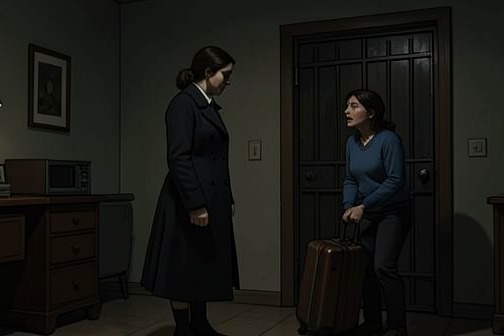
[Sarah Harper](entity:character-recall-character-sarah-harper-825b6fb95487)’s false alibi for [Laura Baines](entity:character-recall-character-laura-baines-a593afcbeb41) obscures the hours surrounding [Joseph Wieder](entity:character-recall-character-joseph-wieder-b197efcd3c56)’s murder while exposing how a personal bond can distort an investigation. Sarah saw Laura only in the early morning after the killing, but later told police that Laura had been with her since lunchtime the previous day. Her account was not a reliable chronology: Sarah had little knowledge of where Laura had been before she arrived, and eventually recognized that Laura’s story did not fit what she herself had witnessed.
## The Request and the Night’s Uncertainty
Sarah recalled that Laura arrived at her apartment in Rocky Hill at about three in the morning. Sarah had gone to bed early because she planned to travel home for the holidays the next day, and a friend had offered her a ride to [New York](entity:location-recall-location-7a11f2949ca3). Laura appeared frightened. She said that she had argued with [Richard Flynn](entity:character-recall-character-richard-flynn-c9f56abe2609), who had taken her flirtation seriously and become obsessed with her, and that she had collected her belongings from the house. Her bags were in the trunk of her car outside. She also said that [Timothy Sanders](entity:character-recall-character-timothy-sanders-b272fc65de2f) had returned a couple of days earlier and that they intended to live together again.
Laura asked Sarah to say that they had spent the whole evening together if anyone asked. Sarah understood this as a request for protection from Richard Flynn: she believed Laura was talking about him, not anticipating that the police might investigate a murder. She agreed, though her later account makes clear that she could not vouch for Laura’s whereabouts throughout the preceding day. Sarah did not know where Laura had been before appearing at her door.
The distinction between the narrow fact Sarah could attest to and the broad alibi she later supplied is central to the episode. Laura arrived during the night and asked for a cover story; Sarah’s eventual statement placed her with Laura from lunchtime onward. It converted a brief, late-night encounter into an apparently continuous account of the day.
## The Lie Becomes a Police Statement
Sarah said that something felt wrong. Laura, ordinarily self-confident in Sarah’s recollection, seemed frightened, but Sarah had just been woken and did not want to hear the details. She made up a bed for Laura on the couch and went back to sleep. By seven in the morning, Laura had left; a note said she had gone to Timothy. Sarah herself left at about eight with her friend.
On the Jersey Turnpike, Sarah learned from the radio what had happened to Joseph Wieder. She asked her friend to pull over and got out to vomit. Her immediate thought was that Laura might somehow have been involved. Nevertheless, when police contacted her between Christmas and New Year, Sarah returned to [New Jersey](entity:location-recall-location-new-jersey-25586b9a9d1c) and said that Laura had been with her from lunchtime until the next morning. The statement turned Sarah’s promise into a false alibi covering hours she had not witnessed.
Sarah later described why she had done it without claiming that she had believed Laura’s account. She thought Laura dominated her and that she was not capable of refusing her. By then the friendship had already deteriorated, and Sarah no longer wanted Laura’s company; even so, she complied. Her choice was therefore not presented as confidence in Laura’s innocence, but as a failure to resist a person who still exerted an emotional hold over her.
## Doubt, Withdrawal, and a Second Explanation
After the police interview, Sarah met Laura for coffee. Laura thanked her and insisted she had nothing to do with the murder. She also said that she had asked Sarah to testify so she would not be harassed by police and reporters. Laura claimed that Joseph Wieder had finally accepted her contribution to his book and promised to name her as a co-author. Sarah found that claim strange, particularly because it concerned a change supposedly made just before Wieder’s death, and she did not believe Laura.
Sarah’s response to the case lasted beyond the interview. Physically and mentally depleted, she spent the holidays in bed, took a sabbatical, and did not resume classes until the fall of 1988. Laura was no longer there when she returned. Laura called several times, but Sarah did not want to speak with her; she told her parents that she had suffered a bad breakup and went to therapy. In the following year, the murder had become old news around [Princeton](entity:location-recall-location-princeton-a416f496f017), and no one asked Sarah about the case again. The silence did not resolve the contradiction in her statement; it left the false account embedded in a story that few people continued to examine.
Years later, [Roy Freeman](entity:character-recall-character-roy-freeman-e521f39f4d5e) confronted Laura with the discrepancy, citing Sarah’s false alibi and the notes [John Keller](entity:character-recall-character-john-keller-d6cf54623bee) had made after speaking with her. Laura did not deny asking Sarah to lie. She said Sarah was fragile and would have given in immediately if questioned forcefully, and explained that she had wanted to stay out of the newspapers and avoid insinuations about her relationship with Joseph Wieder. She said she had not feared a murder accusation, but a scandal. Sarah, then in Maine, could still testify if necessary. The later confrontation thus recast the alibi: it had protected Laura from scrutiny, but Laura’s stated purpose was concealment of a scandal, not concealment of murder.
## Significance in the Investigation
The false alibi matters both for the time it claims to cover and for the limits of what it proves. Sarah’s statement placed Laura with her from lunchtime, although Sarah’s own account began with Laura’s arrival around three in the morning. Sarah could describe Laura’s fear, her request, and the departure note; she could not personally account for Laura’s earlier movements. The lie therefore creates an evidentiary gap rather than filling one. It establishes that Laura sought a cover story and that Sarah knowingly repeated it to police, but it does not by itself establish where Laura was before reaching the apartment or what she did at [Joseph Wieder’s house](entity:object-recall-object-joseph-wieder-f6afa3f32ab5).
The episode also shows how an alibi can acquire authority through repetition. A hesitant agreement made after a night-time arrival became a formal statement, while Sarah’s doubts and incomplete knowledge remained outside its clean timeline. When Roy later returned to the testimony, Laura supplied another motive for the lie, but that explanation did not make Sarah’s statement true. The competing accounts leave the alibi as both an act of personal loyalty and an obstruction to reconstructing the night: its strongest revelation is not a definitive account of the murder, but the extent to which a false chronology had shaped what investigators could know.
Event 9
Disappearance of Wieder’s Unpublished Manuscript
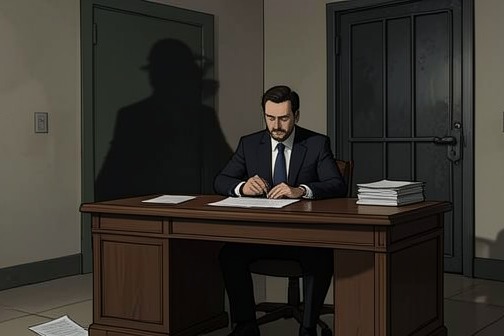
The disappearance of [Joseph Wieder](entity:character-recall-character-joseph-wieder-b197efcd3c56)’s unpublished manuscript is the hinge between a documented publishing history and an unresolved question of authorship. A proposal and contract show that Wieder had presented a book as complete, yet the publisher never received the full manuscript. Later, [Laura Baines](entity:character-recall-character-laura-baines-a593afcbeb41) offered a conflicting account: what Wieder had called his book, she said, was built from her work and fragments of his earlier writing. The surviving record establishes the gap; it does not, by itself, settle what the missing manuscript contained or who had the right to claim it.
## The publishing record
The surviving chronology begins in July [1987](entity:time-recall-time-1987-0da5bb436088), when Wieder sent a proposal to [Allman & Limpkin](entity:organization-recall-organization-allman-limpkin-2619721d371d) with the book’s first chapter enclosed. In the proposal, he said that the manuscript was complete and ready for submission. The publisher sent him a contract in August. Among its terms was a plan for Wieder to begin revising the text with an editor in November.
That schedule changed when Wieder asked for several more weeks to polish the manuscript over the holidays. The publisher granted the extension, but the full manuscript never arrived. The account links this interruption to the tragedy that followed, without showing that the publisher received any further portion of the book. The proposal and contract thus document an intended publication, not a completed handover of the work.
[John Keller](entity:character-recall-character-john-keller-d6cf54623bee) pursued the paper trail the next morning after learning that Wieder’s full manuscript was unaccounted for. An acquisitions editor at Allman & Limpkin directed him to the archive department, explaining that correspondence from the period might have been preserved because authors and publishers then communicated by letter rather than email. The archivist refused to speak to the press without management’s permission. Keller returned to the editor, set out the questions he was trying to answer, and persuaded her to investigate.
Two days later, the editor reported what she had found: the July proposal, the August contract, the request for extra revision time, and the absence of the completed manuscript from the publisher’s files. She attached a scan of the original typewritten proposal, almost fifty pages long. Keller printed the pages, fastened them with a paperclip, and set them aside to read. The substantial surviving document offered a detailed trace of the proposed book, but it could not substitute for the missing manuscript itself.
## The disputed contents
The later investigation turned the question from where the manuscript had gone to whether a finished book had existed in the form Wieder claimed. [Roy Freeman](entity:character-recall-character-roy-freeman-e521f39f4d5e) confronted Laura Baines with Keller’s conclusion that she had taken Wieder’s manuscript and published it as her own first book. The subject of that book, Freeman noted, corresponded to the project described in Keller’s investigation: connections between mental stimuli and reactions. Baines confirmed the shared subject but denied that she had stolen Wieder’s manuscript.
Baines said she had given Wieder an outline for her dissertation and the opening chapters. He had responded enthusiastically and supplied additional material; over time, she said, their work became confused in his mind, until he treated the project as his own. She described the proposal sent to the publisher as claiming that a manuscript was ready when, in her account, no proper book project existed. It comprised chapters from her work and an incoherent blend of excerpts from Wieder’s earlier books.
The chapter comparison sharpened the dispute without resolving it. Freeman said that the first chapter of Baines’s published book was entirely similar to the chapter Wieder had sent to the publisher. Baines answered that Wieder had taken it from her. She also explained why she had not challenged him at the time: she was an unknown scholar, while Wieder was one of the country’s most esteemed psychologists, and she feared an accusation of intellectual fraud would make her seem paranoid. Her account makes the proposal evidence of a possible appropriation, not proof that the missing book was a completed, independently authored manuscript.
## Investigation and uncertainty
Keller’s inquiry had begun with [Richard Flynn](entity:character-recall-character-richard-flynn-c9f56abe2609)’s missing book, but the evidence redirected attention toward Wieder and the older mystery of his own lost manuscript. Keller found that the proposal existed and that it had been submitted; he also learned that the full manuscript never reached the publisher. These facts answered part of his inquiry while opening a different one. The distinction between a proposal, an enclosed chapter, a claimed-complete manuscript, and a delivered manuscript became essential: the documents preserve the first three claims and the chapter, but not the full work.
The record also reflects the limits of the investigation’s other sources. A publisher’s archive retained a proposal and correspondence history, while later accounts supplied competing explanations of the proposed book’s contents. Neither kind of evidence fills the absence left by the manuscript. Keller’s accumulating details seemed to him to form a maze rather than a coherent account, and Wieder’s vanished book came to echo the missing manuscript that had first brought him to the case. That parallel deepened the mystery without establishing that the two losses had the same cause.
## Significance
Wieder’s missing manuscript matters both as a lost object and as a contested claim to authorship. The publishing documents lend weight to the fact that a book was proposed and contracted, while Baines’s testimony challenges the premise that Wieder possessed a finished, original work. The missing pages prevent a direct comparison of the complete texts and leave the central dispute dependent on partial records and retrospective testimony.
The episode also changes the direction of the investigation. What began as a search for Flynn’s book leads Keller toward a second lost work and toward Wieder’s influence over the people and materials around him. Yet the discovery of more records does not produce a definitive solution: the proposal survives, the full manuscript does not, and the accounts of what that manuscript represented remain in conflict.
Event 10
The Death of Anne Simmons
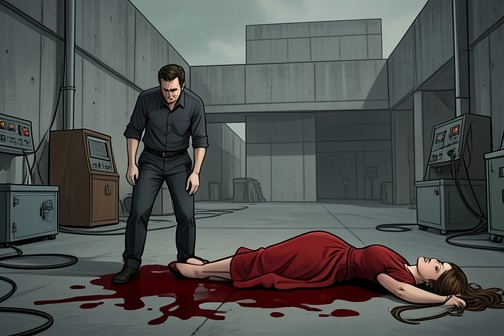
[The Death of Anne Simmons](entity:event-recall-event-762977e1f2ae) is the unresolved killing at the center of [Derek Simmons](entity:character-recall-character-derek-simmons-95698181529e)’s account of his past and [Roy Freeman](entity:character-recall-character-roy-freeman-e521f39f4d5e)’s confrontation with him. Derek says he found [Anne](entity:character-recall-character-anne-8255533dffd4) in a pool of blood and denies murdering her, but his decision to call [Joseph Wieder](entity:character-recall-character-joseph-wieder-b197efcd3c56) before calling emergency services makes the timing look incriminating. Roy believes Derek killed his wife; the novel nevertheless leaves the facts of her death uncertain, and its closing reflections place that uncertainty within a wider pattern of characters mistaking their suspicions for what they actually witnessed.
## The Morning of Anne’s Death
Derek’s account begins with the discovery of Anne’s body. When Roy asks whether he killed her, Derek shakes his head and insists that he found her lying in a pool of blood. He adds that he knew she had been unfaithful, presenting that knowledge as part of the circumstances surrounding his response. The novel supplies no independent description of how Anne died, so Derek’s account establishes what he claims to have seen, not a verified reconstruction of the killing.
What Derek did next gives the morning its central contradiction. Rather than immediately calling for help, he telephoned Wieder, whom he believed to be Anne’s lover, and warned him that the police might make him a scapegoat. Derek said he would draw Wieder into the case by exposing their relationship. He also invoked his history of psychiatric hospitalization, suggesting Wieder could arrange for him to be found not guilty by reason of insanity and committed to a forensic hospital. Derek called 911 eight minutes after that conversation. Roy later emphasizes the interval: the person Derek describes as the love of his life was lying in a pool of blood, yet Derek first called the man he believed had been sleeping with her and asked for protection.
## The Call and Its Investigative Trail
Derek says he had found Wieder’s home number while rummaging through Anne’s belongings. He called from his own house because he was afraid of being seen and needed to speak to Wieder quickly; he did not know whether the arriving patrol would arrest him on the spot. His explanation connects the call’s timing to his fear of immediate suspicion, but it also confirms that the call was deliberate and that he understood its potential significance.
The call record initially led nowhere. Wieder had only recently bought the house, and its telephone number had not yet been transferred into his name. The number remained associated with the former owner, Jesse E. Banks, who had died; the property had passed through an estate agency. Police checking the calls therefore reached a dead end and dropped the lead. Even if they had identified Wieder, Roy notes, his name had not seemed relevant to the case at that time. The administrative break in the trail helps explain why Derek’s call did not immediately expose the connection he claimed existed between Anne and the professor.
## Derek’s Suspicions and Roy’s Challenge
Derek portrays his belief in an affair as grounded in circumstance rather than certainty. He says he did not know how Anne and Wieder had met, but speculates that they might have encountered one another at the coffee shop where she worked, a place frequented by professors and students. He describes Wieder as wealthy, powerful, and famous, and assumes that the professor would do everything possible to avoid a scandal. The account reveals Derek’s suspicion and his use of that suspicion as leverage; it does not establish that Anne and Wieder were lovers.
Roy challenges both Derek’s accusation against Anne and the reliability of his account. Referring to the detectives’ investigation, Roy says Anne had worked for about two years as a barmaid at Ruby’s Cafe in Atlantic City before she met Derek. People interviewed about her described her as decent, intelligent, and kind. Roy rejects Derek’s picture of her as promiscuous and mocked by other men, suggesting that the imagined enemies and humiliations may have belonged to Derek’s fears rather than Anne’s life. He also says he is unsure whether she had an affair with Wieder at all; she may instead have sought the professor’s help. In this reading, the alleged affair that Derek uses to explain his call and frame his grievance remains an open question.
## Aftermath and Uncertainty
The consequences of the morning extend beyond the call. Derek was eventually arrested and accused of murdering Anne. He was declared legally insane and committed to [Trenton Psychiatric Hospital](entity:location-recall-location-trenton-psychiatric-f51e12b71666). His claim that Wieder could use his psychiatric history to affect his legal fate thus sits alongside the actual outcome: institutional commitment after the accusation. Later, after Derek was attacked at the hospital and emerged from a coma with amnesia, he remembered Wieder as a caring doctor, unaware of the earlier threat and suspicion that had shaped their relationship. That later rupture helps explain why his account of the murder comes through a memory restored after a period of profound loss, rather than through an uninterrupted record of events.
Roy’s belief remains an accusation, not a confirmed solution. Derek denies killing Anne, while Roy tells him directly that he thinks he did. The ending widens the uncertainty rather than resolving it: the characters have repeatedly interpreted other people through obsessions and mistaken assumptions. The novel concludes that Derek may have been wrong about the affair, just as other characters were wrong about what they believed they had seen. Anne’s death therefore remains both a personal tragedy and a test of the difference between testimony, suspicion, and established fact.
Event 11
Derek Simmons’s Arrest and Hospitalization After His Wife’s Murder
[Derek Simmons’s arrest](entity:action-recall-action-derek-simmons-s-arrest-5ba6fa207273) and hospitalization after [Anne](entity:character-recall-character-anne-8255533dffd4)’s murder became a turning point in both his life and the later investigation of [Joseph Wieder](entity:character-recall-character-joseph-wieder-b197efcd3c56)’s death: an attempt to use his psychiatric history as leverage gave way to a legal insanity finding, institutional confinement, an attack, and the loss of his memory. Recalled through Simmons’s account, the episode also explains why investigators treated his later claims as unreliable, even though he insisted he had witnessed crucial events.
## The Call and the Arrest
On the morning Anne was killed, Simmons called Wieder after finding the professor’s home number among Anne’s belongings. He warned Wieder that the police might make him a scapegoat and threatened to involve him by disclosing what Simmons believed was an affair between Wieder and Anne. Simmons also pointed to his previous admission to a mental hospital, arguing that Wieder could help ensure he was found not guilty by reason of insanity and committed to a forensic psychiatric institution. The call turned the alleged relationship into leverage: Simmons was not merely accusing Wieder but invoking the possibility that Wieder could influence what happened to him.
Simmons was subsequently arrested on suspicion of murdering his wife. He was declared legally insane and committed to [Trenton Psychiatric Hospital](entity:location-recall-location-trenton-psychiatric-f51e12b71666). The account establishes this sequence but does not resolve the underlying question of Anne’s death or prove that Wieder and Anne had been lovers. Simmons later described Wieder as rich, prominent, and much older than Anne, and said he believed Wieder would avoid a scandal; those were Simmons’s convictions, not independently confirmed facts.
## Attack, [Coma](entity:state-recall-state-coma-c9fd4d76e48c), and Amnesia
Before Simmons could be transferred to [Marlboro Hospital](entity:location-recall-location-marlboro-hospital-e93ed2c4f999), another patient attacked him at Trenton Psychiatric Hospital. The assault left him in a coma. On waking, he recognized no one, could not remember his name, and did not know how he had come to be in the hospital. Tests led staff to conclude that the amnesia was genuine rather than feigned.
The attack radically altered Simmons’s relationship to Wieder. Previously, Simmons had threatened to expose him; after waking, Simmons remembered none of that history and experienced Wieder as a kind, attentive doctor. Wieder said he would treat Simmons without charge and arrange his transfer to Marlboro Hospital. Simmons recalled being overwhelmed by this care, a response made possible by the very memory loss that had erased the earlier conflict.
## Release and a New Life
Simmons stayed at Marlboro Hospital for several months without recovering his memories. He gradually learned basic facts about his past, including who his parents were and where he had attended high school. What he learned included his mother’s death, his psychiatric hospitalization, his difficult job, his wife’s alleged infidelity, and the accusation that he had murdered her. Overwhelmed by this history, he stopped trying to recover it and decided to begin again after release.
Wieder chaired the panel that approved Simmons’s release. Because Simmons had nowhere to go, Wieder found him lodging near his own home and gave him work as a handyman there. Simmons could still repair things despite being unable to remember when or how he had acquired those skills. His memory loss, as he described it, severed knowledge of his personal identity without erasing practical abilities. The arrangement placed him close to Wieder and made the professor both his benefactor and employer.
## Testimony and Its Credibility
Simmons later said he knew who had killed Wieder and that he had told the police at the time. He believed his statement had been dismissed because he had previously faced a murder accusation, been confined to a psychiatric hospital, taken medication, and could therefore be portrayed as delusional or unreliable. His account of the night of Wieder’s death implicated [Richard Flynn](entity:character-recall-character-richard-flynn-c9f56abe2609) and suggested that [Laura Baines](entity:character-recall-character-laura-baines-a593afcbeb41) might have been an accomplice or witness, but Simmons said he had withheld her name from police because he feared a scandal would tarnish Wieder’s reputation.
The surviving investigative discussion reinforces the credibility problem without resolving it. A police interviewer remembered that Simmons was ill and amnesiac and considered his statement of little practical value; the alleged affair and Laura Baines’s reported alibi could not be substantiated as proof that she had been at the scene. Later, when Simmons’s version was compared with [Frank Spoel](entity:character-recall-character-frank-spoel-0e4d7bb194da)’s account of the same night, Simmons allowed that Spoel might have forgotten or might be lying. The discrepancies leave Simmons’s testimony contested rather than confirmed. His hospitalization thus functions not only as a biographical rupture but as part of the evidentiary history: the attack erased his memories, while his psychiatric record continued to shape how others judged what he said.
Event 12
Derek Simmons’s Attack and Amnesia at Trenton State Hospital
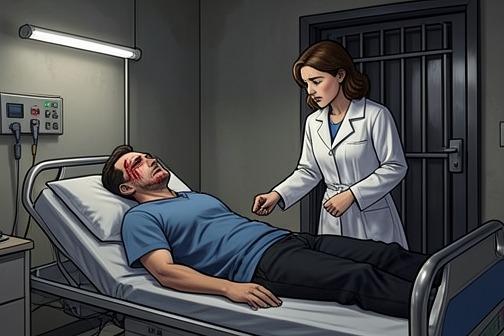
[Derek Simmons](entity:character-recall-character-derek-simmons-95698181529e)’s attack at [Trenton Psychiatric Hospital](entity:location-recall-location-trenton-psychiatric-f51e12b71666) turned a period of confinement into a rupture in his identity: after emerging from a coma, he could not recognize anyone or remember even his own name. The amnesia gave [Joseph Wieder](entity:character-recall-character-joseph-wieder-b197efcd3c56) a new place in his life—as the doctor who seemed to care for him—while leaving Simmons’s earlier history and its connection to the Wieder murder inaccessible to him. The attack’s consequences extended beyond the hospital, shaping his release, his later recollections, and the weight investigators gave his testimony.
## Background and Hospitalisation
After [Anne](entity:character-recall-character-anne-8255533dffd4) was murdered, Simmons was accused of killing her and declared legally insane. He was committed to Trenton Psychiatric Hospital. Wieder visited him there, ostensibly because of a professional interest in his case, and promised that he would arrange a transfer to the more comfortable [Marlboro Hospital](entity:location-recall-location-marlboro-hospital-e93ed2c4f999) within three months. The attack occurred before that transfer could take place, interrupting the course Wieder had described.
## The Attack and Loss of Memory
Another patient attacked Simmons at Trenton, leaving him in a coma. When he regained consciousness, he recognized no one and did not know how he had ended up in hospital; he could not even recall his name. Medical staff conducted tests and concluded that the amnesia was genuine, not feigned. The episode therefore did more than obscure particular details: it severed Simmons from the personal history through which he might have understood his arrest, his marriage, and his connection to Wieder.
## Care, Transfer, and a New Life
During the period of amnesia, Wieder appeared to Simmons as a friendly, attentive doctor. He offered to treat him without charge and to secure his transfer to Marlboro. Simmons stayed there for several months without recovering his memory. He gradually learned basic facts about his identity and past, including who his parents were and where he had attended high school, but those disclosures brought back a history he found bleak: his mother’s death, his hospitalisation, a miserable job, an unfaithful wife, and the accusation of murder. He gave up trying to recover more and resolved to begin again after leaving the hospital.
Wieder chaired the panel that approved Simmons’s release. Since Simmons had nowhere to go, Wieder found him accommodation near his own house and gave him work as its handyman. Simmons could still repair things, even though he could not remember when or how he had learned those skills. This distinction between practical ability and autobiographical recollection became part of his new life: some capacities endured when the story of the person who had acquired them did not.
Wieder’s care also shaped how Simmons understood him. Wieder ensured that he took his treatment, paid him a regular wage for repairs, took him fishing, and spent evenings with him at least weekly. On one occasion, he took Simmons to the university and hypnotised him, without telling him what the session had revealed. For Simmons, who had lost access to his former identity, Wieder’s sustained kindness became the basis of an intimate trust.
## Memory’s Return and Its Consequences
In March [1987](entity:time-recall-time-1987-0da5bb436088), Simmons saw a television news item on [NY1](entity:organization-recall-organization-ny1-100220f47315) about a man from Bergen County who had died by suicide. He recognized the man, Stan Marini, as a former member of the maintenance crew at [Siemens](entity:organization-recall-organization-siemens-1608a2ad199e), where Simmons had once worked. The recognition mattered because Simmons believed he was recalling something no one had told him and that he had not read. He described the memory’s return as a buried mass suddenly surfacing, arriving with the speed of a film accelerated far beyond its normal pace. The report did not restore his identity all at once, but it offered him evidence that memories from his earlier life remained beneath the amnesia.
The attack’s consequences also affected how Simmons’s account of Joseph Wieder’s murder was received. He later insisted that he had known who killed Wieder and had told the police, but believed his history of psychiatric commitment and medication made his statement easy to dismiss. His recollections implicated [Richard Flynn](entity:character-recall-character-richard-flynn-c9f56abe2609) and suggested that [Laura Baines](entity:character-recall-character-laura-baines-a593afcbeb41) had either assisted or witnessed the killing; Simmons also said he had withheld her name from the police because he feared publicity would tarnish Wieder’s reputation. These were claims he made, not independently established facts. Their force was further complicated by contradictions between his account and [Frank Spoel](entity:character-recall-character-frank-spoel-0e4d7bb194da)’s, including disagreement about who had been at the house and whether Laura had been present. A detective remembered Simmons as ill and amnesiac and regarded his statement as offering little that investigators could use.
## Narrative Significance
The event makes memory loss both a personal catastrophe and a problem of evidence. Simmons’s coma and amnesia explain why his identity and testimony could not be treated as straightforward records of the past, but they do not by themselves establish that his later recollections were false. The novel repeatedly distinguishes a memory’s vividness or certainty from its reliability: Joseph Wieder’s experiment with hypnotically suggested memories of getting lost in a mall shows how suggestion can produce detailed recollections, while Simmons’s later recognition of Stan Marini gives him a reason to believe that some memories have returned without such prompting. His story leaves the reader to weigh these different sources of memory rather than treating either conviction or diagnosis as conclusive.
Event 13
Derek Simmons Recovers His Memories
[Derek Simmons’s recovery of his memories](entity:action-recall-action-derek-simmons-s-recove-42d3fb485666) begins with an ordinary television news report and overturns the life he thought he understood. In March [1987](entity:time-recall-time-1987-0da5bb436088), recognizing a former [Siemens](entity:organization-recall-organization-siemens-1608a2ad199e) coworker on screen brings back memories that Derek believes no one had supplied to him. What follows is both a personal revelation and a test of the novel’s recurring uncertainty: recovered recollections can restore a buried past, but their force and vividness do not by themselves settle what happened.
## The Trigger and Its Context
Before the memories returned, Derek had been living with retrograde amnesia. [Joseph Wieder](entity:character-recall-character-joseph-wieder-b197efcd3c56) had helped secure his release, found him a place to stay near the professor’s house, and given him work as a handyman. Derek could still repair things, though he could not remember when or how he had learned those skills. Wieder also ensured that he took prescribed pills, paid him for repairs, took him fishing, and spent time with him regularly. Derek regarded him as a benefactor and a close friend; Wieder had even hypnotized him once at the university, without telling him what the session had revealed.
One evening in the middle of March, Derek was flicking through television channels when he saw an [NY1](entity:organization-recall-organization-ny1-100220f47315) news item about a man from Bergen County who had killed himself. The photograph made him think of Stan Marini. As he was about to change the channel, he recognized Marini as one of the maintenance crew at Siemens, where Derek had once worked. He also remembered that Marini had married around the same time he had and later moved to [New York City](entity:location-recall-location-new-york-city-65df0a129d4c). The report had not been presented as a deliberate attempt to recover Derek’s past; an incidental face on television had become the cue that opened it.
## The Return of the Past
Derek understood the recognition as more than a guess based on the broadcast. He believed he was remembering something no one had told him and that he had not read about. The memories then seemed to surge rather than arrive one at a time: he compared the experience to oil bursting from the ground after a hidden layer had been lifted. He described the past as moving through his mind at a speed far beyond ordinary viewing.
Afraid that the memories might vanish again, Derek decided not to call Wieder late that evening. Instead, he found a notebook and wrote down whatever came into his mind. That act gives the recovery a tangible record, but the account does not establish that the notes independently verify every recollection. The recovered sequence, as Derek later recounts it, includes meeting [Anne](entity:character-recall-character-anne-8255533dffd4), the early happiness of their marriage, her alleged infidelity, and his discovery that she was having an affair with Wieder. It also brings back what he says happened that morning, his arrest, and his difficult experience in the hospital. The memories reconnect intimate betrayal with the institutional history that followed, making the return of the past a reordering of Derek’s identity as well as a recovery of particular events.
## Wieder Recast as Guardian
The most consequential change is Derek’s reinterpretation of Wieder. He had thought of the professor as the friend who supported him after his release; after his memories return, he studies the labels on the pills Wieder prescribed and asks a pharmacist whether they are for amnesia. He is told they are for flu and indigestion. Derek then concludes that Wieder was not treating his memory loss with those pills but was keeping him close in order to watch him in case he remembered what had happened.
That conclusion transforms the meaning of the professor’s care without making the interpretation an independently confirmed fact. In Derek’s recovered account, regular visits, employment, housing, and attention can be read as a benefactor’s kindness or as a means of maintaining oversight. The same relationship that had made Wieder seem trustworthy now appears to Derek to have concealed fear of the past. For several days, he avoids leaving the house. When Wieder visits, Derek claims he has a headache and wants to sleep; he says he almost felt sorry that the amnesia had lifted. His silence is deliberate: he hides the recovery from the very person whose role it has made suspect.
## Memory, Testimony, and Uncertainty
The event sits within a story that repeatedly separates the vividness of a memory from its reliability. [Laura Baines](entity:character-recall-character-laura-baines-a593afcbeb41) explains that a person may mistake a story heard in childhood for a personally witnessed event; she illustrates how the mind can erase the source of a recollection and substitute an experience. She also describes eyewitness accounts that conflict over basic details, such as the color of a car. Joseph Wieder’s mall experiment makes the danger more concrete: after hypnosis suggested that students had been lost in a shopping mall as children, three-quarters later described the supposed experience in detail, despite having no original memory of it.
These examples do not disprove Derek’s recovered memories, but they prevent his certainty from functioning as proof on its own. His experience feels immediate and self-authenticating to him, while the novel has already shown how suggestion, forgotten sources, and later interpretation can shape recollection. The distinction matters because Derek’s claims concern both an intimate relationship and the murder of Wieder. Earlier, investigators discounted his statement in part because he had amnesia and had been considered mentally ill; decades later, Derek himself challenges another witness’s account by suggesting that the man may have forgotten or lied. The account therefore leaves two questions in tension: whether Derek has regained access to what happened, and whether anyone—including Derek—can separate recovered memory from the story built around it.
Event 14
The Death of Joseph Wieder
[The Death of Joseph Wieder](entity:event-recall-event-821f0145c15f) is disclosed in [Derek Simmons](entity:character-recall-character-derek-simmons-95698181529e)’s retrospective account as a killing completed in a moment of recognition. Wieder had already been savagely beaten when Derek found him, but Derek chose to strike him again rather than summon help. That distinction shapes the event’s moral and factual stakes: Derek did not begin the first assault, yet his final blow and deliberate departure left Wieder to die.
## The Visit for the Toolbox
Derek says that after recovering his memory he had often thought about killing Wieder, but feared going to prison or a psychiatric hospital. On the day of the killing, however, he describes a more ordinary immediate reason for going to Wieder’s house: he had left his toolbox there after fixing a downstairs toilet, and needed it for a job near home the following morning. He and Wieder had eaten lunch together earlier. Derek first went around to the backyard, where he saw the living-room lights on and Wieder sitting at a table with [Richard Flynn](entity:character-recall-character-richard-flynn-c9f56abe2609).
Derek did not encounter Richard Flynn. He came back to the front, unlocked the door, took the toolbox from beside the coat rack, and left without either man realizing he had been there. On his way home, he imagined that if something happened to Wieder, Richard Flynn would be blamed: Derek regarded him as a man in love with a woman Wieder was pursuing, and thus as someone with an apparent motive. The later confession overturns the suspicion Derek himself had helped anticipate. Richard Flynn was present before the murder, but Derek says he was not the person who had beaten Wieder.
## The Return to the House
At around eleven, Derek went to a bar intending to establish an alibi. He spoke with the owner, Sid, who knew him, and exploited the fact that Sid wore no watch and had no clock on the wall: before leaving, Derek told him it was midnight. Sid later testified to that time without realizing Derek had supplied it. The episode makes the alibi an act Derek deliberately constructed, rather than an innocent mistake about when he had been there.
Derek says he still had not decided what to do when he returned to Wieder’s house. He carried a leather sap he had found months earlier in the glove compartment of a car he was repairing. Quietly unlocking the front door, he entered and found Wieder on the floor, badly beaten, with blood everywhere. The windows stood open. Derek shut them and turned off the lights, keeping a flashlight with him. He believed Richard Flynn must have argued and fought with Wieder after Derek’s earlier visit; in his account, the severity of the beating made him think the assailant had been willing to risk killing him.
## Recognition and the Fatal Blow
Derek’s first response to the injured man was divided. He says he might have fled or called an ambulance, uncertain what to do. Then, while he leaned over Wieder with the flashlight beside him, Wieder opened his eyes and looked up. That gesture changed the meaning of the scene for Derek. The sight brought back his memory of following [Anne](entity:character-recall-character-anne-8255533dffd4) into a hotel, climbing the stairs, and listening at the door while she was with Wieder. Derek connects that recollection to the humiliations he says he suffered in the marriage and to his grievance that Wieder had pretended to be his friend, had slept with his wife, and had put him in a psychiatric institution before bringing him out to serve as his jailer.
After Wieder looked at him, Derek says, he took out the blackjack and hit him once, hard. The blow did not initiate the beating: Wieder was already lying gravely injured, his face swollen, bruised, and smashed. But Derek’s account makes the last strike a conscious act, precipitated by recognition and remembered betrayal. The narrative therefore separates the unknown person who first assaulted Wieder from the man who chose, at the bedside, to make the violence final.
## Departure and Aftermath
Derek locked the door, threw the blackjack into the lake, and went home. Before sleeping, he pictured Wieder lying dead and says that he felt good, with no remorse for what he had done—or, as he framed it, for finishing what someone else had started. He returned to the house the next morning. He says that he did not learn Richard Flynn was not the person who had first beaten Wieder until [Roy Freeman](entity:character-recall-character-roy-freeman-e521f39f4d5e) came to see him days before this account, and that he had scarcely thought about the killing until a reporter arrived.
Roy Freeman tells Derek that the medical examiner said Wieder died two hours after the assault, and that an ambulance could have saved him. Derek maintains that he is sure Wieder died on the spot, but adds that it no longer matters. The disagreement preserves an important distinction between the medical finding and Derek’s recollection; it does not undo his admission that he withheld aid and struck Wieder. The recovered account also recasts the apparent evidence against Richard Flynn: his presence with Wieder earlier that evening made him an easy suspect, while Derek’s manufactured bar alibi and disposal of the weapon concealed the role he himself played.
## Narrative Significance
The event reaches the reader through Derek’s later telling, which gives the confession the structure of a memory returning in stages. First comes the apparently routine visit for a forgotten toolbox; then the staged alibi and the return to the house; finally, Wieder’s opening eyes reconnect the injured body before Derek to the remembered betrayal of years earlier. The murder’s decisive turn is thus not the discovery of the beating but Derek’s recognition of the man on the floor.
Derek’s account is also marked by a tension between responsibility and self-excuse. He distinguishes his blow from the original beating and repeatedly presents the killing as completion rather than initiation, yet he also admits that he struck Wieder, concealed his presence, discarded the weapon, and left without summoning help. His insistence that Wieder was already dead conflicts with the medical examiner’s reported conclusion that he survived for two hours. The event’s significance lies in that unresolved interval: Derek describes himself as finishing another person’s violence, while the consequences of his own choice to leave Wieder without aid remain central to the death.
Event 15
Derek Simmons’s Confession to Killing Wieder and Arrest
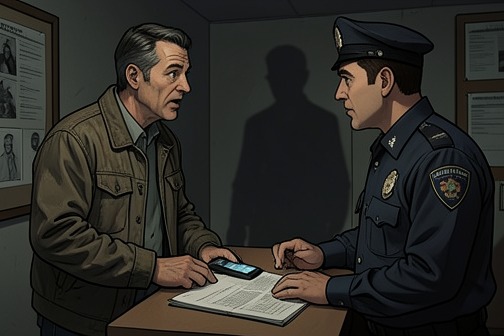
[Derek Simmons’s Confession to Killing Wieder and Arrest](entity:event-recall-event-5d35c041ac1d) is the revelation that identifies Simmons as the person who delivered the final blow to [Joseph Wieder](entity:character-recall-character-joseph-wieder-b197efcd3c56). [Roy Freeman](entity:character-recall-character-roy-freeman-e521f39f4d5e)’s renewed investigation links a previously overlooked telephone record to the old murder; when Freeman confronts Simmons, the confession both clarifies Wieder’s death and leaves the circumstances of [Anne](entity:character-recall-character-anne-8255533dffd4) Simmons’s killing unresolved. The admission leads into Simmons’s arrest and collapses the appearance that [Richard Flynn’s manuscript](entity:object-recall-object-richard-flynn-s-manusc-5070cf3310ba) had explained the crime as straightforward fact.
## The Overlooked Lead
The confession follows Freeman’s recognition that the Simmons and Wieder cases, separated by four years, belonged in the same investigation. A call listing showed that Simmons had telephoned Wieder on the morning in question. The call lasted fifteen minutes and forty-one seconds, but its number was still associated with Jesse E. Banks, the deceased former owner of Wieder’s newly purchased house. Investigators had reached a dead end while checking the calls and dropped the lead; at the time, even a connection to Wieder would not have seemed relevant to their case.
Once the significance of the address and number became clear, Freeman spent two hours assembling the details of the two cases. He laid out his papers during a long meeting with an assistant at the [Mercer County Prosecutor’s Office](entity:organization-recall-organization-dd07fd5e1d26); the assistant contacted Chief Brocato to confirm the details. This preparation turns the confession into the result of a recovered investigative connection, not a chance disclosure. Freeman approaches Simmons with a specific question grounded in the old call record, and Simmons recognizes that the detective has uncovered the conversation he made to Wieder.
## The Confrontation and Simmons’s Denial
Before Simmons tells the story, Freeman waits rather than pressing him to speak. He believes Simmons has been waiting a long time to tell someone the whole account and expects that Simmons will leave town and not return. Freeman describes the moment as one in which a suspect seems ready to tell the truth, but insists that the telling must take its own course. The pause establishes the confession as a choice Simmons makes under questioning, after Freeman has shown that the abandoned telephone lead is no longer hidden.
Freeman first asks whether Simmons killed his wife. Simmons shakes his head and denies it. He maintains that he found Anne in a pool of blood, although he says he knew she had been cheating on him and believed she deserved what happened. The denial is not an account that identifies Anne’s killer: it preserves the distinction between Simmons’s knowledge of her affair and responsibility for her death. That unresolved earlier crime is the emotional background to what he does admit about Wieder.
## The Account of Wieder’s Death
Simmons says that he had long thought about killing Wieder after recovering his memory, but had refrained because he did not want to go to jail or a psychiatric hospital. On the night Wieder was attacked, Simmons had forgotten his toolbox at the house. He had repaired the downstairs toilet earlier, eaten lunch with Wieder, and needed the toolbox for a job near his own home the following morning. When he went to retrieve it, he first circled around to the backyard and saw the living-room lights on. Through the window, he saw Wieder at the table with [Richard Flynn](entity:character-recall-character-richard-flynn-c9f56abe2609), then a student.
Simmons describes finding Wieder on the floor, gravely injured but not yet dead. He says he did not know whether to leave, call an ambulance, or do something else. As he leaned over Wieder, with a flashlight lit beside him, Wieder opened his eyes. Simmons says that look brought back the memory of following Anne to a hotel room and listening outside the door, as well as the humiliation and anger he associated with their relationship. He connects the remembered affair, Wieder’s role in his life, and his own resentment to the decision that followed. The confession thus distinguishes the person who first beat Wieder from the person who completed the attack.
Simmons admits that he took out a blackjack and struck Wieder once, hard. He locked the door, threw the blackjack into the lake, and went home. He recalls feeling no remorse, thinking instead that he had finished what another man had started. He returned to the house the next morning, but says he did not learn that Flynn had not been the person who beat Wieder until Freeman visited him days before the confession. Simmons had treated the matter as buried until the reporter’s arrival brought it back into view.
## Recording, Arrest, and Consequences
Freeman tells Simmons that Wieder died two hours later, according to the medical examiner, and that an ambulance might have saved him. The detail fixes the consequence of Simmons’s decision not to summon help: his blow was delivered to an injured man who could still have been rescued, and Simmons knowingly left him there. The account also explains why the morning telephone call mattered. Simmons had contacted Wieder quickly from his home because he feared being seen and did not know whether police would arrest him when they arrived.
Freeman secretly records the confession with a special pencil in his jacket pocket, without wires. After he parts from Simmons and drives away from Witherspoon Street, he hears police sirens. The novel later identifies Simmons’s arrest as the consequence of the disclosure, although the sirens alone do not show the precise moment or procedure of his arrest. Freeman’s thoughts after leaving remain unsettled: he wonders whether Wieder had hypnotized Simmons, whether the professor understood his patient’s capacity for violence, and whether the apparent permanence of Simmons’s amnesia had concealed a danger that was present all along.
## The Manuscript’s Reversal
Simmons’s confession changes the meaning of Flynn’s account without making every element of the earlier cases certain. After Simmons is arrested, [Peter Katz](entity:character-recall-character-peter-katz-cf2a408def07) understands that the premise of the manuscript as a true-crime solution has been blown apart: Flynn’s theory had embellished real events through his imagination. The arrest removes the mystery that had made the manuscript a possible explanation of Wieder’s death, but it does not turn Simmons’s denial about Anne into proof of who killed her.
The confession is therefore both a resolution and a limit. It identifies Simmons’s final blow, explains the discarded telephone lead, and supplies his stated reason for leaving Wieder without help. At the same time, it reaches the reader through a suspect’s retrospective account, secretly recorded by a detective whose own investigation has only recently joined the two cases. The conclusion replaces the apparent certainty of a manuscript with testimony that settles one decisive act while leaving another death unresolved.
Event 16
The Death of Richard Flynn
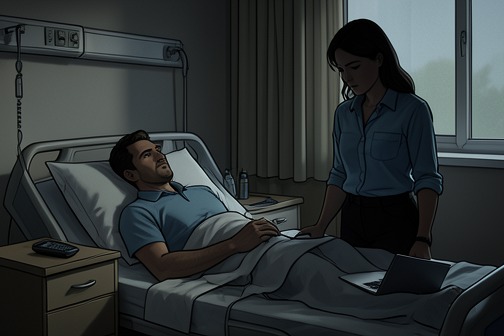
[Richard Flynn](entity:character-recall-character-richard-flynn-c9f56abe2609)’s death matters less as a fully recounted scene than as the absence around which the novel’s investigation gathers. He dies before the manuscript he spent his final months writing can be published, leaving behind a partial account of events that [Peter Katz](entity:character-recall-character-peter-katz-cf2a408def07) initially treats as a route to the truth. The later discovery that Flynn’s theory was mistaken changes the meaning of both the book and its author’s last effort: the manuscript survives, but not as a reliable solution to the mystery it set out to explain.
## An absence at the center of the investigation
The available account does not describe the circumstances of Flynn’s death in detail. It establishes that he was hospitalized and that [Danna Olsen](entity:character-recall-character-danna-olsen-38cc5128540d) took his calls on her cell phone during the first day after his admission. She later stopped taking them; his brother Eddie, his colleagues, and others knew about his condition, but she could not access his email because she did not have his password. When Katz asked whether she knew where the rest of the manuscript was, she said she did not. She nevertheless offered to search the small Lenovo laptop Flynn had left behind, while making clear that she would need to speak to him before handing the manuscript over if she found it. The promise was shaped by a loss that had already made Flynn unable to answer for himself.
That missing manuscript gives the death an investigative afterlife. Katz is looking for Flynn’s book, but the search draws him into the earlier history of [Joseph Wieder](entity:character-recall-character-joseph-wieder-b197efcd3c56) and the disputed events around Wieder’s death. After visiting [Susanne Johnson](entity:character-recall-character-susanne-johnson-16e35273ccd3), Katz contacts [Allman & Limpkin](entity:organization-recall-organization-allman-limpkin-2619721d371d) to establish what had happened to Wieder’s proposed book. The publisher’s archive initially refuses to speak with the press, but an acquisitions editor eventually finds the records: Wieder submitted a proposal and its first chapter in July [1987](entity:time-recall-time-1987-0da5bb436088), said the manuscript was complete, and received a contract the following month. He was due to begin revisions with the editor in November, then asked for more time to polish the work over the holidays. The full manuscript never reached the publisher; tragedy intervened. This documentary sequence supplies a concrete record of a book interrupted, while leaving the missing text itself beyond the archive’s reach.
## From Flynn’s manuscript to a maze of records
The investigation’s changing focus reflects the uncertainty left by Flynn’s death. Katz begins by following Flynn’s manuscript, but comes to feel lost among details that refuse to form a coherent picture. In his diagram, the inquiry becomes a maze: he is surrounded by information whose significance he cannot yet read. The narrative emphasis shifts with him. Flynn, initially the central figure as the manuscript’s author, recedes, while Wieder’s public stature and history move to the foreground. Even the relationship between the real [Laura Baines](entity:character-recall-character-laura-baines-a593afcbeb41) and the figure in Flynn’s manuscript resists a clear match; Katz cannot superimpose the two images.
Records from separate cases add another strand without immediately resolving it. In the morning, Katz happens upon a phone number while reviewing the list of twenty-eight calls made and received on [Derek Simmons](entity:character-recall-character-derek-simmons-95698181529e)’s phone around his wife’s murder. One entry is associated with Jesse E. Banks and a call lasting fifteen minutes and forty-one seconds. Katz recognizes the address and realizes that the name and number, overlooked by investigators in [1983](entity:time-recall-time-1983-6f606aa14b4c), matter to his inquiry. When he had begun investigating Wieder’s death in December 1987, he had not thought to connect it with a case from four years earlier. The phone record does not itself explain the connection, but its delayed significance exemplifies the way the investigation assembles meaning from documents created for other purposes.
## Danna Olsen’s confession after the case
The clearest reversal concerning Flynn’s final manuscript arrives only after the main investigation has changed course. A few days after the story of Derek Simmons reaches the news, Olsen calls Katz while he is traveling to [Los Angeles](entity:location-recall-location-los-angeles-11eff639bdf5). She admits that she had known where the rest of Flynn’s manuscript was and had read it before his death. She had withheld it because the book made clear how deeply Flynn had loved Laura Baines, despite his anger toward her. Olsen felt betrayed: she had cared for Flynn through the eccentricities of his last months, while he devoted that time to writing about another woman. Her earlier claim that she did not know where the manuscript was is thus exposed as a deliberate concealment, not a failure of access.
Olsen’s decision to send the manuscript changes the question attached to Flynn’s death. She explains that his last wish was for the book to be published and that, although he had not lived to see it, she now believes sending it to Katz is the right thing to do. But the manuscript arrives after the case has been transformed. Simmons has been arrested; [Roy Freeman](entity:character-recall-character-roy-freeman-e521f39f4d5e), the retired detective, has become a media figure; and [John Keller](entity:character-recall-character-john-keller-d6cf54623bee) has told Katz that the mystery is no longer a mystery. The events have, in Katz’s assessment, disproved Flynn’s theory and shown how his imagination embellished real events. The book remains a possible publication, but its claim to tell a true-crime story has collapsed.
## An unfinished legacy and the limits of certainty
Katz eventually finds the manuscript in his inbox after returning to [New York](entity:location-recall-location-7a11f2949ca3). He prints all 248 pages, in 12-point Times New Roman, double-spaced, and leaves them in a file on his desk without yet reading them. The physical pages become a reminder of Flynn’s unrealized ambition and of the limits of what can now be recovered: the manuscript exists, but Katz delays the reading that might disclose its contents. At dinner, he acknowledges that it could be sold as a book, while Keller points out that it would not be true. Katz’s response—that Flynn was unlucky even after death, having missed his chance to publish—makes the lost publication a human consequence without restoring the manuscript’s authority as evidence.
The ending places Flynn among several people whose interpretations prove unreliable. Katz concludes that Flynn was probably wrong to the end; that Baines probably stole Wieder’s manuscript and left him dying, but was not Wieder’s mistress; and that Simmons was mistaken about Flynn fleeing through the glass door after attacking Wieder. Wieder, too, had been wrong about a relationship between Baines and Flynn. These are presented as Katz’s final probabilities and judgments, not as a fresh scene of Flynn’s death or an account that settles every detail. The pattern is more decisive than any single reconstruction: each person has looked through the past as if through a window, only to find a mirror reflecting private obsession. Flynn’s death therefore leaves not a final authoritative version of events, but an unpublished book whose supposed explanation is overtaken by the very uncertainty it tried to master.